
The complete guide
Buying an Engraved Compass for Your Husband, A Practical Guide
The problem with buying for a husband
Most gifts for a long-term partner fall into two piles. There is the useful pile, socks, tools, a new kettle, which is fine but says nothing. Then there is the sentimental pile, framed photos, printed mugs, cards with long poems, which says plenty but usually ends up in a cupboard within a year.
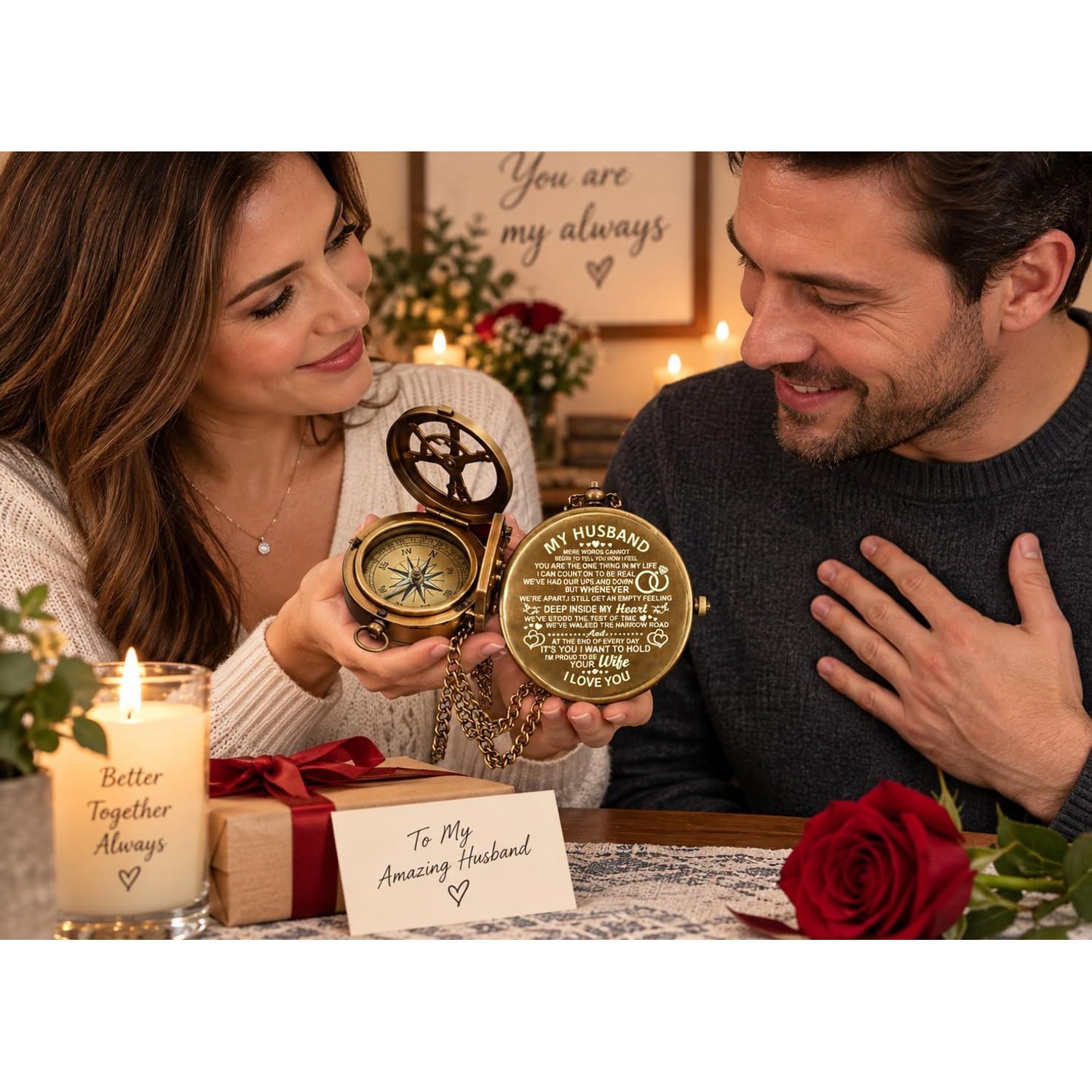
An engraved brass compass tries to sit between the two. It is an object with a job. It opens, it points, it has moving parts. And it carries a message on the back that he will see every time he turns it over. That combination is why keepsake compasses keep selling when other romantic gifts go in and out of fashion.
This guide covers how the piece works, who it genuinely suits, what to check before you buy, and how to keep it looking right over the years.
How a sundial compass actually works
There are two instruments here, stacked into one small brass body.
The first is the magnetic compass. Under the glass sits a needle balanced on a pivot, magnetised so that one end swings toward magnetic north. That is why it needs to be held flat and reasonably still, and why it hates being near steel desks, car dashboards, laptop speakers and magnetic phone mounts. Move it away from the interference and it settles again. Nothing is broken when the needle wanders near metal, that is just how magnets behave.
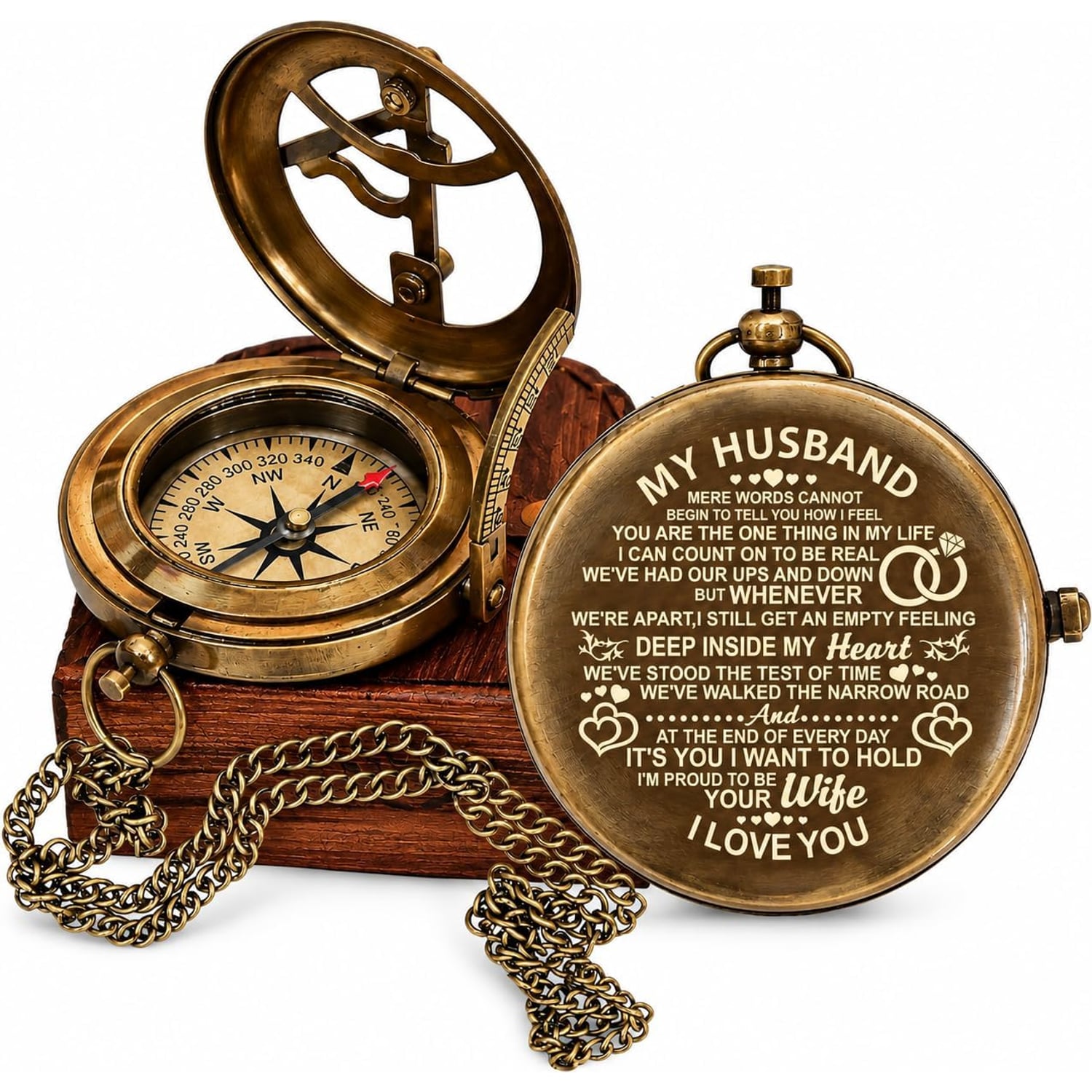
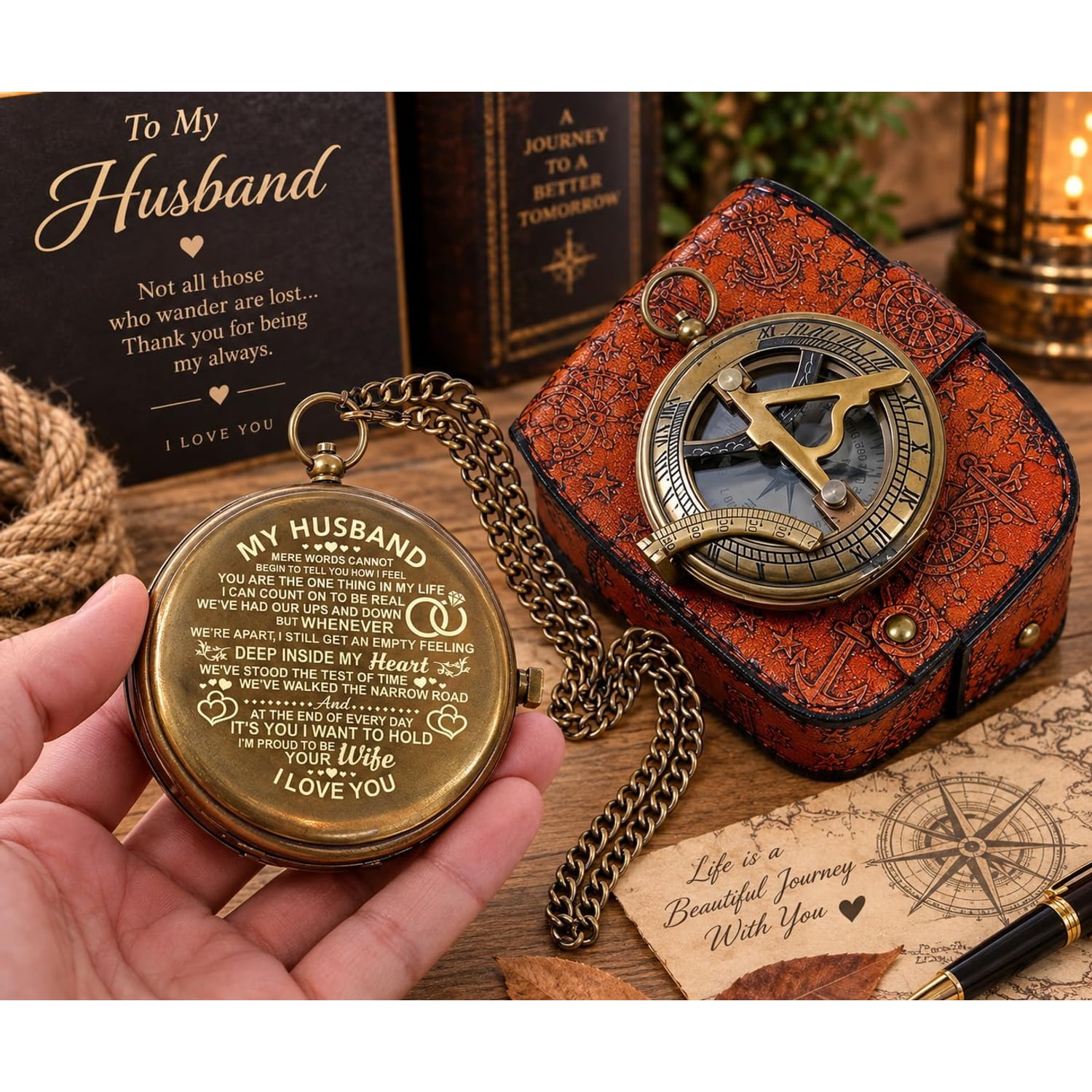
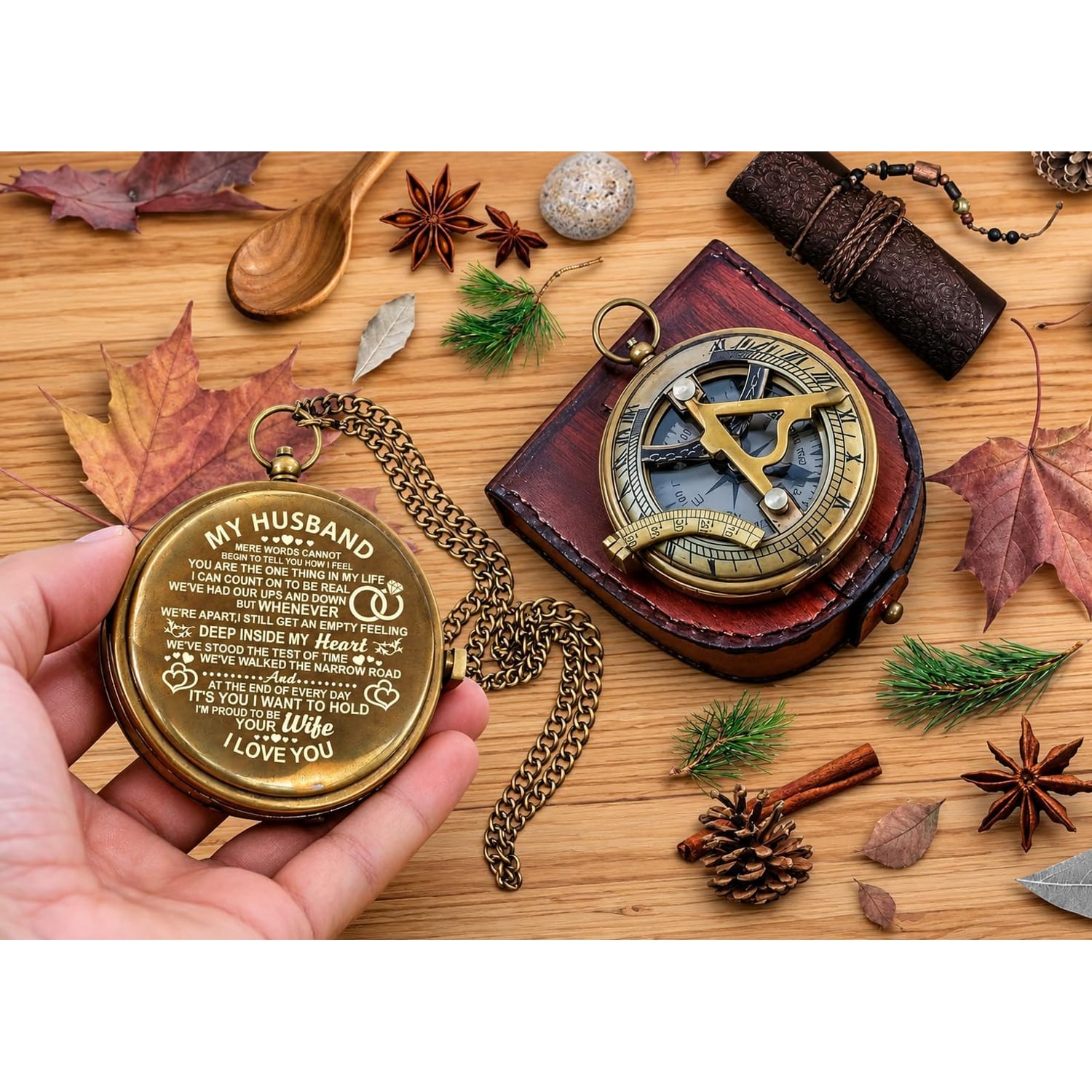
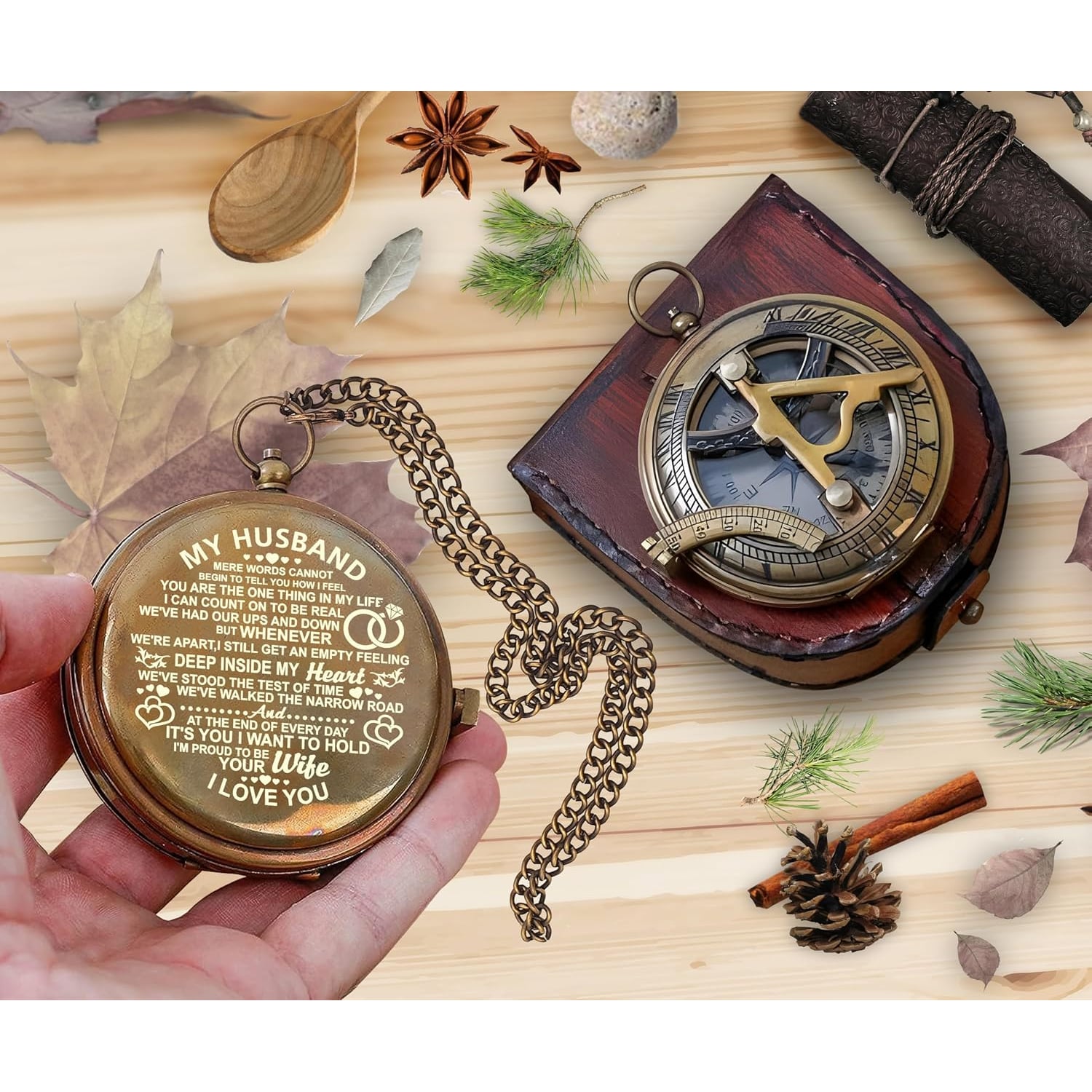
The second is the sundial. The small arm hinged to the dial face is called a gnomon. Fold it up, set the compass flat, turn the whole thing until the needle reads north, and the gnomon throws a shadow across the hour markings etched on the face. Read where the shadow falls and you have an approximate time.
Approximate is the honest word. A sundial's accuracy depends on the latitude it was marked for, the time of year, and whether your clocks have jumped forward for summer. Somebody standing in Oslo and somebody standing in Singapore will get different results from the same dial. Nobody buys one of these to replace a watch. They buy it because reading the time off the sun is a genuinely pleasing thing to do, and because it is a conversation that starts itself when the piece is sitting open on a desk.
Why brass matters
A lot of decorative compasses are made from plated zinc alloy. They look fine in photographs and then chip at the edges after a season in a pocket. Brass behaves differently. It is heavier, it takes an engraving cleanly, and when the finish wears it goes warmer and darker rather than flaking.
This one is listed at about 0.22 kg for a piece that is 7.6 cm across. Pick it up and the weight registers straight away. That heft is doing quiet work, it is the difference between something that feels like a model and something that feels like a tool.
The antique-style finish also forgives use. Small marks blend in. Fingerprints wipe off. If he actually carries it, which is the point, the compass will slowly pick up the look of something that has been somewhere. That is a feature, not wear and tear.
Who it suits, and who it does not
It lands well with a few types.
The traveller, obviously, or anyone who likes maps, sailing, hiking or old instruments. The collector, who has a shelf of brass and leather things and will be pleased to add another. The sentimental type who keeps ticket stubs, because he will register the engraving immediately. And the man who is hard to buy for because he already owns every gadget, since this is deliberately not a gadget.
It lands less well with a committed minimalist who keeps nothing on display, or with somebody who needs a genuine survival-grade navigation tool for serious backcountry work. For that job a modern baseplate compass with a declination adjustment is the right buy, and a keepsake compass rides along as the nice one.
Be realistic about which of those your husband is. The best keepsake compass for him is the one that matches how he actually lives, not the one that matches the photograph.
Choosing between options
If you are comparing several engraved compasses, a few things separate the good from the forgettable.
Check that the compass is described as working. Plenty of decorative pieces have a painted dial and a fixed needle. This one lists a working compass as the special feature, which is the part that keeps it interesting after the first week.
Check the size. Around 7.6 cm is the sweet spot. Much smaller and the dial gets fiddly to read, much larger and it stops being pocketable and becomes an ornament only.
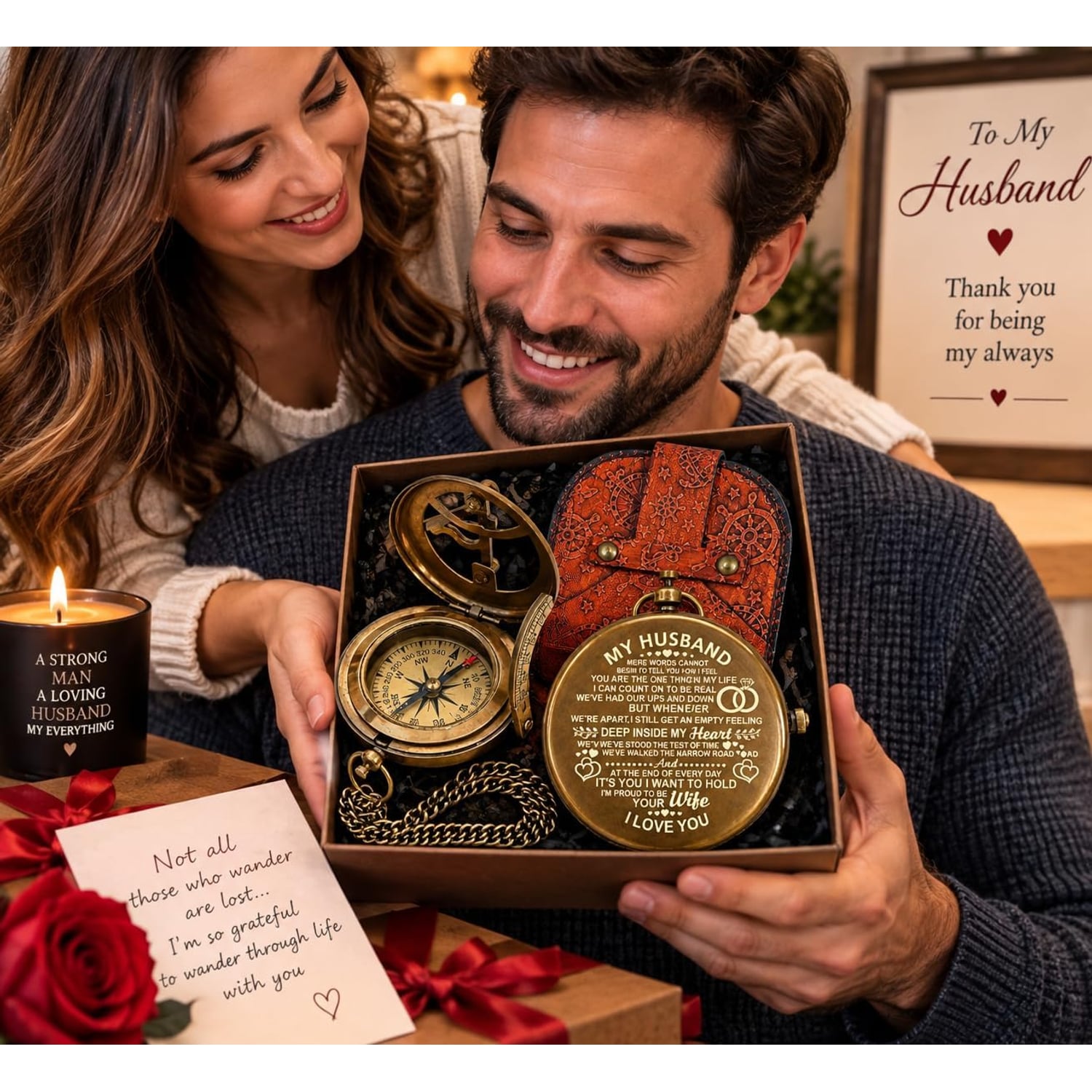
Check what comes in the box. A leather case is worth having, both for presentation and for the years afterwards when it needs somewhere safe to live. A chain is a small extra that makes it easier to carry without losing.
Check the engraving method. Engraved into the metal lasts. Printed or lacquered text does not. Since this one carries a fixed My Husband message rather than a custom line, what you see is what arrives, which also means no spelling risk and no proofing delay.
Care that actually extends its life
Brass care is simple and mostly about restraint.
Wipe it with a soft, dry cloth after handling. Skin oils are the main thing that dulls the surface, and a quick wipe deals with them. Leave the household sprays and solvents in the cupboard, they can stain brass unpredictably and can soften the crispness of engraved lines.
Resist the urge to polish it to a mirror. An antique finish is applied deliberately. Hard polishing strips it back and the piece loses the character you paid for. If a patch looks tired, a dry buff is usually enough.
Keep it dry. No water rating is specified for this compass, so rain and sinks are not its friends. If it does get wet, dry it straight away rather than letting moisture sit around the glass.
Store it in the leather case when it is not out. Loose in a drawer, the glass picks up scratches from keys and coins. In the case, it stays as it arrived.
And keep strong magnets away. A magnetic phone mount sitting beside it on a desk will confuse the needle. Move the magnet, give it a moment, and the needle finds north again.
Making it feel like a gift
Half the value of a keepsake is the moment it changes hands. The leather case does the heavy lifting here, so there is no scramble for wrapping paper.
A few things make it land harder. Write a short note that says where you would like to go together, since a compass invites that sort of thinking. If you are marking an anniversary, add the year somewhere on the card rather than expecting the object to carry the date. And give it in a quiet moment rather than in the middle of a crowded room, because it is a thing he will want to open and turn over, not something to hold up for applause.
The short version
This is a brass sundial compass with a working magnetic needle, a fold-up gnomon, and a My Husband message engraved into the back. It is 7.6 cm across and arrives with a chain and a leather case.
Buy it if he likes objects with a bit of history to them and you want a gift that still means something in a decade. Skip it if he needs a serious navigation instrument or keeps nothing on a shelf.
Treat it kindly, keep it dry, keep it away from magnets, and it will outlast most of the other presents you will ever give him.